


.svg)


.svg)




.svg)

-2.svg)
-1.svg)


.svg)


.svg)
.svg)
.svg)

.svg)

.svg)
.svg)


.svg)

.svg)
.svg)
.svg)
.svg)
.svg)
.svg)
.svg)
.svg)
.svg)


.svg)
.svg)
.svg)
.svg)


.svg)
-1.svg)
.svg)
.svg)
.svg)

.svg)
.svg)

.svg)
.svg)

.svg)
.svg)
.svg)
.svg)
.svg)
.svg)
.svg)
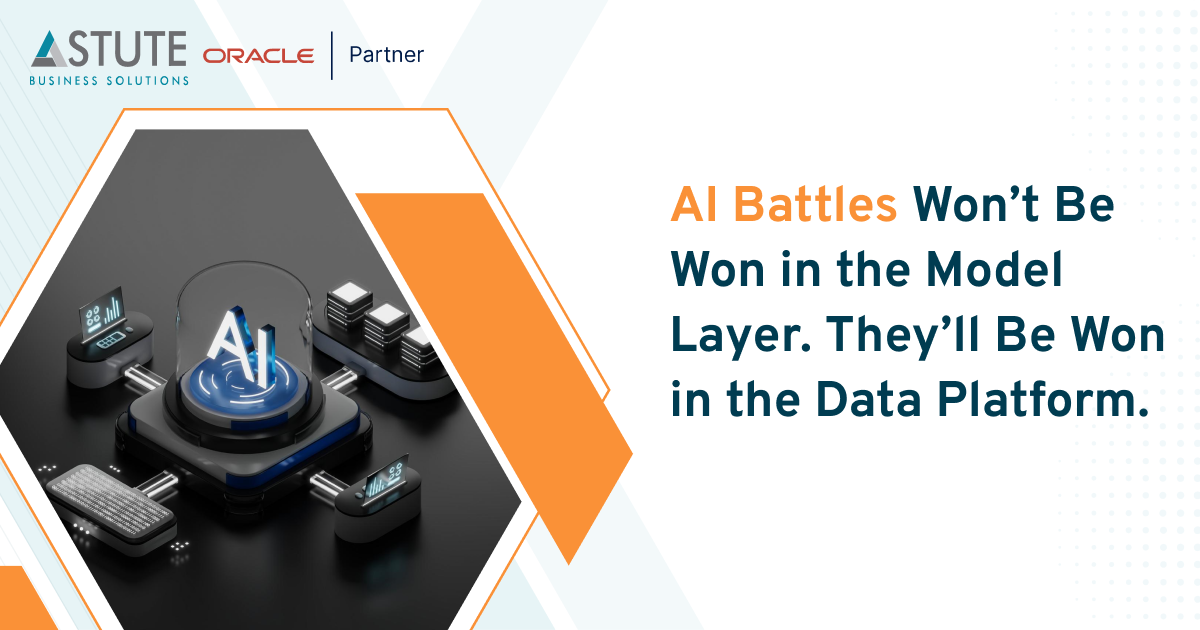



Table of Contents
Everyone is talking about models, copilots, and agents. But inside the enterprise, the decisive advantage in AI is not going to come from who has access to the newest model release. It’s going to come from who built the best data platform.
That may sound less exciting than a breakthrough model demo, but it’s the more consequential truth. In enterprise AI, the winners will not be the companies with the most AI pilots. They will be the companies that can reliably turn fragmented, fast-changing, governed, enterprise data into usable context for AI systems at scale.
In other words: AI is becoming a data platform competition.
The model is not the moat
Foundation models are rapidly becoming more accessible, more interchangeable, and more commoditized. Enterprises can buy model access from multiple vendors, fine-tune open models, route workloads across providers, and increasingly abstract model choice behind orchestration layers.
That changes where differentiation lives.
If every competitor can access similar reasoning capabilities, then the real moat shifts to the layer underneath:
- Which company can connect AI to the right internal data?
- Which company can trust the outputs because lineage, permissions, and semantics are intact?
- Which company can serve structured and unstructured context in real time?
- Which company can support not just chatbots, but AI embedded in workflows, decisions, and operations?
Those are not model questions. They are data platform questions.
Why the AI race is really a data architecture race
For years, enterprises treated data platforms primarily as analytics infrastructure: warehouses for BI, lakes for cheap storage, ETL pipelines for reporting, and governance programs to keep regulators happy.
AI changes the job description.
A modern enterprise data platform is no longer just the back end for dashboards. It is becoming the runtime context layer for AI. It has to supply models and agents with the right data, in the right format, with the right access controls, at the right time, and with enough semantic structure that the system can act with confidence.
That means the platform now has to do five things simultaneously:
1) Unify fragmented enterprise data
Most enterprises still have data spread across SaaS systems, warehouses, document repositories, data lakes, event streams, and operational applications. AI does not eliminate that fragmentation; it amplifies the cost of it.
A chatbot can survive with partial context. An AI agent that is expected to answer correctly, make recommendations, trigger actions, or operate inside a workflow cannot.
If customer history is in one system, contracts in another, support interactions in a third, and product telemetry in a fourth, the quality of the AI experience will be constrained by the weakest connection in that chain.
2) Support both structured and unstructured data
Enterprise AI runs on more than tables. It also depends on contracts, PDFs, emails, tickets, call transcripts, policies, Slack threads, logs, images, and knowledge-base content.
That is why the architecture conversation is moving beyond classic warehouse thinking. AI needs platforms that can bring together structured data for precision and unstructured data for context, while still preserving governance and performance.
3) Add semantic context, not just storage
Storing data is not the same as making it intelligible to an AI system.
The winning platforms will not simply centralize data; they will organize it into something machine-usable:
- metadata and lineage
- business definitions
- access policies
- entity relationships
- retrieval layers
- vector indexes and hybrid search
- knowledge and semantic layers that help agents understand what the data means, not just where it lives
This is where the conversation shifts from “where is our data?” to “can our AI reason over enterprise context safely and accurately?”
4) Govern AI at the data layer
As soon as AI moves from experimentation into production, governance stops being optional.
It is one thing for an employee to use a general-purpose assistant for drafting. It is another thing entirely to deploy AI into customer support, legal review, finance operations, engineering workflows, or autonomous agents with tool access.
At that point, the enterprise needs answers to questions like:
- What data was the model allowed to access?
- Which version of a document or dataset informed the output?
- Was the response grounded in approved enterprise knowledge?
- Can we audit the chain of retrieval, transformation, and action?
- Are sensitive records masked, segmented, or blocked appropriately?
- Can we enforce policy consistently across analytics, ML, and agentic workflows?
The data platform becomes the control plane for trust.
5) Operate in real time, not just batch
Traditional analytics platforms were often designed around historical analysis and periodic reporting. Enterprise AI increasingly requires something else: fresh context.
A sales copilot needs the latest account activity. A supply chain assistant needs current inventory and shipment data. A fraud workflow needs live events. An internal engineering agent needs up-to-date system telemetry and documentation. A customer support bot needs today’s policy changes, not last quarter’s exports.
The AI systems that create business value will be the ones connected to live operational reality. That puts streaming, event-driven pipelines, low-latency retrieval, and continuously updated knowledge layers at the center of the platform discussion.
1782367329-01%201.png?width=512&height=768&name=AI%20battles%20will%20be%20won%20in%20the%20Data%20platform%20-%20Blog_Image%20(2)1782367329-01%201.png)
Why lakehouses are getting so much attention
This is why data lakehouses are gaining momentum in the AI conversation. They sit at the intersection of several enterprise needs: consolidating structured and unstructured data, reducing the sprawl between lakes and warehouses, supporting multiple workloads, and creating a more unified foundation for analytics, ML, and AI applications.
That matters because enterprises are tired of stitching together one stack for BI, another for data science, another for document retrieval, and yet another for AI experimentation. The more fragmented the foundation, the harder it is to operationalize AI across the business.
Lakehouses are attractive not because they magically solve AI, but because they help solve a more foundational problem: they reduce architectural fragmentation at the exact moment AI needs a more coherent data substrate.
But we should be careful not to oversimplify the story. The lakehouse is not the finish line. It is one important piece of a broader platform shift.
The real objective is not “adopt a lakehouse.” The real objective is to build an AI-ready data platform that can:
- consolidate and expose enterprise data safely
- serve analytics, ML, and generative AI from a common foundation
- support retrieval, semantic enrichment, and agent workflows
- enforce governance and observability across the stack
- remain open enough to evolve as the AI ecosystem changes
The next AI winners will build a context engine, not just a data estate
The companies that pull ahead in AI will not just have “better data.” They will build something more specific: a context engine for the enterprise.
That context engine will combine:
- a governed core data platform
- real-time and batch ingestion
- metadata, catalog, and lineage systems
- vector and hybrid retrieval capabilities
- semantic models and knowledge layers
- policy enforcement and access controls
- orchestration that connects AI systems to enterprise tools and workflows
This is the layer that transforms raw enterprise information into actionable, trusted context for AI.
And it is likely to become the most important control point in the stack.
Today, many organizations still think about AI in terms of model selection: Which LLM should we standardize on? Should we use a frontier model or a smaller domain model? Should we build agents now or wait?
Those are valid questions. But they are downstream questions.
The more strategic question is this:
Do we have a data platform capable of turning our enterprise knowledge, processes, and signals into an operational advantage for AI?
Because if the answer is no, then every AI initiative above it will struggle:
- copilots will hallucinate or lack context
- RAG systems will retrieve stale or irrelevant content
- agents will break on permissions, missing data, or inconsistent definitions
- governance teams will slow deployment because the trust layer is weak
- costs will rise because the system compensates for poor data foundations with more prompts, more retrieval, and more manual oversight
The AI platform war is really about ownership of enterprise intelligence
This is why I believe the next phase of enterprise AI will not be defined by who “uses AI.” It will be defined by who owns and operationalizes enterprise intelligence through their data platform.
The winners will have platforms that compound:
- every workflow creates new signals
- every interaction improves retrieval and relevance
- every governed dataset becomes reusable across teams
- every semantic asset makes the next AI use case easier to deploy
- every control built once can be reused across many AI applications
That compounding effect is what turns AI from a collection of pilots into an enterprise capability.
And that is also why the stakes are so high.
If your data platform remains fragmented, under-governed, warehouse-only, or disconnected from operational workflows, AI will remain expensive, brittle, and hard to scale.
If your data platform becomes the governed context layer for the business, AI becomes far more than a chatbot strategy. It becomes a new operating model.
The Takeaway for CIOs, CDOs, and Data Leaders
The AI conversation in the boardroom often starts with models. It should quickly move to platforms.
The central strategic question is no longer, “What’s our AI strategy?”
It is increasingly, “What data platform will allow our AI strategy to work?”
That requires a shift in mindset:
- from isolated AI use cases to shared AI infrastructure
- from dashboard-era data architecture to context-era data architecture
- from storing data to activating governed enterprise knowledge
- from experimentation at the edge to platform capability at the core
The companies that understand this early will have an advantage that is difficult to copy.
Because in enterprise AI, the real battle is not for access to intelligence.
It is for control of the platform that makes intelligence usable.

Other Articles
Lorem Ipsum is simply dummy text of the printing and typesetting industry.
.jpg)
Don’t Move the Foundation to Upgrade the Roof: Why AI Proves You Can Delay Your SaaS Migration
For nearly a decade, enterprise IT leaders have been boxed into a singular, unyielding vendor...
Agentic AI Scales Multi-tier Enterprise Workflows 5x Faster than Traditional RPA
For the past decade, CIOs and Enterprise Architects have leaned heavily on Robotic Process...

Stabilize VMware Costs & Simplify Your Cloud Transition
Broadcom recently bought VMware, which is bringing change for the vmware product and vmware...
.svg)
See The Team In Action
Upcoming Events
- PeopleSoft
- AI for ERP
Cloud, AI, and PeopleSoft at RECONNECT ’26

- Accounts Payable - AP
- Higher Education
- AI Agents
- AI for ERP
- GenAI